







Industrial Wi-Fi Coverage Stability and Infrastructure Cost Optimization
Industrial Wi-Fi networks are fundamentally different from typical office or home wireless installations. In warehouses, production halls, logistics centers, and large industrial facilities, wireless infrastructure must provide not only coverage, but also predictable behavior, stable roaming, controlled latency, and long-term operational reliability.
Many industrial Wi-Fi problems are caused not by insufficient signal strength, but by unstable RF design, excessive interference, poor roaming behavior, overloaded airtime, or incorrectly optimized infrastructure.
In practice, achieving stable industrial Wi-Fi often requires a completely different design philosophy than maximizing theoretical throughput or chasing speed test results.
Industrial Wi-Fi Is About Stability, Not Only Speed
Consumer Wi-Fi marketing usually focuses on maximum Mbps values. Industrial environments operate under different priorities.
In real industrial deployments, the most important factors are often:
- stable coverage,
- predictable roaming behavior,
- low retransmission rates,
- controlled airtime utilization,
- stable packet timing,
- minimal communication interruptions,
- high long-term reliability.
A warehouse barcode scanner losing connectivity for two seconds during roaming may create larger operational problems than a network delivering lower peak throughput.
For this reason, industrial Wi-Fi design should prioritize consistency and RF stability rather than laboratory maximum speed values.
Coverage Design Directly Affects Infrastructure Cost
One of the biggest misconceptions in industrial Wi-Fi is the assumption that more access points automatically create a better network.
In reality, excessive AP density often creates:
- higher interference levels,
- larger airtime overhead,
- more roaming events,
- additional retransmissions,
- higher installation costs,
- more complex maintenance.
Carefully optimized coverage using appropriate antenna systems may significantly reduce the required number of access points while simultaneously improving network stability.
This becomes especially important in:
- high-bay warehouses,
- production halls,
- cold storage facilities,
- large logistics centers,
- outdoor industrial areas.
External Antennas Can Improve Coverage Control
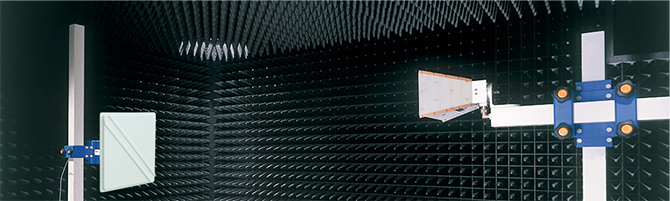
Industrial Wi-Fi deployments often benefit from directional or sector antennas that allow engineers to better control RF propagation.
Unlike omnidirectional coverage, properly selected external antennas may:
- reduce unnecessary reflections,
- limit overlapping cells,
- improve SNR consistency,
- reduce interference between APs,
- improve roaming predictability,
- optimize airtime usage.
Well-designed antenna systems may also reduce the total infrastructure cost by decreasing the number of required access points, switches, PoE ports, mounting locations, and maintenance points.
Industrial RF Environments Are Highly Challenging
Warehouses and industrial facilities create RF conditions that differ significantly from office environments.
Common challenges include:
- metal racks and reflections,
- moving machinery,
- forklifts and AGV vehicles,
- large open spaces,
- concrete walls,
- variable inventory levels,
- electromagnetic interference.
These factors often create unstable signal behavior even when average RSSI appears acceptable.
As a result, industrial Wi-Fi design requires much more than simple heatmap coverage planning.
Roaming Stability Is Critical
Industrial mobile devices frequently move between coverage cells while actively transmitting data.
Poor roaming optimization may cause:
- temporary communication interruptions,
- latency spikes,
- packet loss,
- retransmission bursts,
- application instability.
In many real deployments, proper roaming behavior is more important than achieving the highest PHY rates.
Latency and Airtime Efficiency Matter
Industrial systems are often sensitive not only to throughput, but also to transmission timing consistency.
Applications such as:
- barcode scanners,
- VoIP systems,
- telemetry,
- PLC communication,
- AGV control,
- real-time monitoring
may become unstable when latency variation and retransmission levels increase.
Efficient airtime utilization and low interference levels are therefore often more important than maximum channel width.
Infrastructure Optimization Reduces Long-Term Costs
Industrial Wi-Fi should always be analyzed not only from the perspective of initial installation cost, but also long-term operational cost.
Optimized RF design may reduce:
- the number of APs,
- switch infrastructure requirements,
- PoE distribution complexity,
- maintenance time,
- downtime risk,
- future expansion cost.
A stable and predictable network is often significantly cheaper to maintain over many years than a network designed only for maximum coverage density.
Conclusion
Industrial Wi-Fi infrastructure requires a completely different design approach than consumer wireless networks.
Stable coverage, controlled roaming, efficient airtime usage, optimized antenna systems, and predictable RF behavior are often more important than maximum theoretical throughput.
Carefully optimized infrastructure may simultaneously improve operational stability and reduce total deployment cost.
Related Articles
- Packet Latency and Jitter in Wi-Fi Networks
- Packet Retransmissions in Industrial Wi-Fi
- Roaming Optimization for Warehouse Terminals
- Airtime Efficiency and Beacon Overhead
- Designing Wi-Fi for Barcode Scanners and Mobile Terminals
- Fiber Backbone and PoE Distribution
- Redundancy Design for Industrial Wi-Fi